What does a plumping face cream actually do?
It helps dry skin look fuller by improving hydration. That is the whole mechanism. A cream cannot add volume under the skin the way a procedure can.
When skin is dry, it can look flat, rough, or papery. Fine lines show more. A cream that holds water at the surface softens that look. Think of it as moisture-driven smoothness, not a change in structure.
Why does moisture make skin look smoother and fuller?
The outer layer of skin, called the stratum corneum, behaves differently when it holds more water. A 2022 review of moisturizers in the journal Cosmetics explains that moisturizers make skin smoother by increasing the water content of that layer. The same review links them to relief from tightness, itching, and stinging in dry skin.

There is a limit to what this tells us. Only the abstract is openly available, and the review is about moisturizers in general. It does not test peptides or any plumping claim. So it supports the hydration part of the story, and nothing more.
How long do plumping effects last compared with other approaches?
Hydration effects fade when you stop using the product. They also depend on your skin, your climate, and how often you apply. The table below shows what each principle can reasonably offer.
| Plumping principle | What to expect | How long it lasts |
|---|---|---|
| Water-binding ingredients such as hyaluronic acid | Skin looks softer and more cushioned | Short-lived; fades if you stop applying |
| Barrier-supporting ingredients such as ceramides | Less tightness, smoother surface | Builds gradually with steady use |
| Rich emollient texture | Skin feels comfortable and looks glossy | Short-lived; wears off through the day |
| Texture-focused actives, used steadily | A subtle change in the look of firmness | Gradual and mild; varies by person |
None of these rows replaces a medical or cosmetic procedure. If you want a different level of change, a dermatologist is the right person to ask.
What should you look for on the label?
Start with the basics. The American Academy of Dermatology's moisturizer guide points to ingredients such as ceramides and hyaluronic acid when you choose a moisturizer for dry skin. It also advises applying moisturizer right after bathing to limit water loss.
That page is patient guidance. It does not mention plumping or peptides, so treat it as a foundation rather than a verdict on any one formula. If your skin is mostly dehydrated rather than dry, our dehydration collection gathers hydration-first options in one place. For a gentler routine, see a hydration-first glass skin moisturizer routine.
Where does Super Volume Cream fit in?
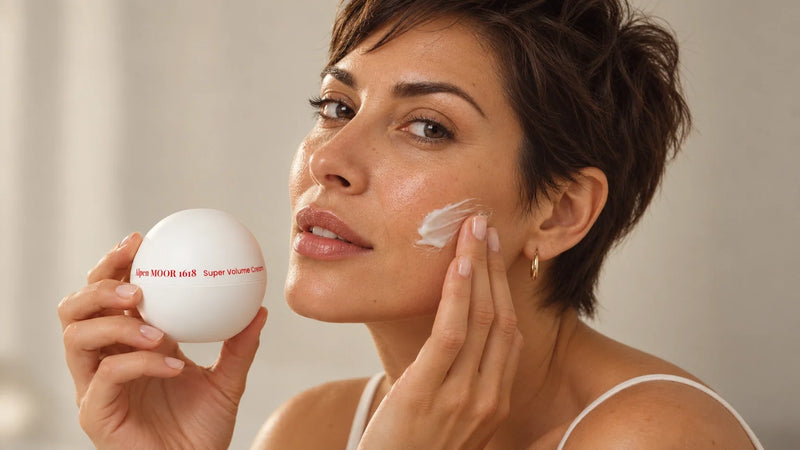
Our Super Volume Cream is a rich balm that melts into skin and leaves a soft, non-greasy finish. It is made for skin that feels dry, tired, or less firm over time. It pairs Volufiline, HPR Retinoid, a 10-vitamin complex, and a 5-peptide complex, aimed at the look of firmness and a smoother texture.

You can use the cream morning or night, on the face, neck, and around the eyes. A thin layer is enough, and it also works as a smooth base before makeup. For more on the ingredient, read what Volufiline is and how it works in a firming cream.
What should you know before trying it?
Be realistic. Results are subtle, and a cream cannot lift sagging skin. It softens the look of dryness and fine lines, nothing more.
The formula contains HPR Retinoid. If you use a prescription retinoid, check with your prescriber before layering the two. Start every other night, then adjust based on how your skin feels. Keep it off the eyelids and the lash line. If your skin reacts, stop and speak with a dermatologist.
FAQ
Is a plumping cream the same as a filler?
No. A filler is placed under the skin by a professional. A cream works on the surface, helping skin hold water so it looks smoother. Any change is temporary and much milder.
Can I use a plumping face cream under makeup?
Yes, in most cases. A hydrated, smooth surface gives makeup an even base. Use a thin layer and let it settle for a few minutes before applying foundation or concealer.
Should I apply it in the morning or at night?
Either works for a cream built around Volufiline, which is not photosensitive. Many people use it in both routines, but those new to retinoids may prefer evenings while their skin adjusts.