What does a barrier cream need to do first?
A 2019 narrative review in MDPI Cosmetics describes the main lipids of the outer skin layer as cholesterol, free fatty acids, and ceramides, in roughly equal proportions. It says their ordered alignment helps limit water loss. Limits: it is a narrative review with no new trial data, and it notes that it is still debated whether topical ceramides reach deeper layers. It does not cover peptides.
So a barrier cream starts with moisture and lipids. Humectants hold water, and oils and emollients soften skin and slow evaporation. Our guide on moisturizer for a damaged skin barrier covers this in more detail. Peptides come after these basics, not before.
Where do peptides fit in a barrier cream?
Peptides are short chains of amino acids that skincare formulas use as supporting ingredients. In a barrier cream they sit on top of a base of moisture and lipids. They do not replace ceramides, cholesterol, or fatty acids, and they are not a stand-in for a well-built moisturizing base.
That order matters when you read a label. A cream can list peptides and still rely on humectants and oils for most of the comfort.

What are the limits of topical peptides?
A 2025 review in MDPI Cosmetics notes that many peptides are hydrophilic and prone to breakdown by enzymes in the upper skin layers. It names stability and penetration as a limit across all peptide types. Limits: it is a review, not a trial, so it measures no product. It cites small participant groups, varied designs, and does not discuss trial funding.
Peptides still have a place. A peptide is one part of a formula, though, and we would not expect it to do a lipid's job.
How do you tell a barrier cream from a peptide cream?
Look at what the product is built around. A barrier cream is built around moisture and lipids. A peptide cream leads with peptides in its marketing. The two overlap, and many creams are both.
| Ingredient group | Role in a cream | Evidence level |
|---|---|---|
| Barrier lipids (ceramides, cholesterol, fatty acids) | Make up the skin's own lipid layer; topical versions are used to support it | Well described in skin; debated for how far topical ceramides reach (2019 review) |
| Humectants | Hold water in the outer layer | Not assessed in the reviews we read |
| Oils and emollients | Soften skin and add a nourished feel | Not assessed in the reviews we read |
| Peptides | Supporting ingredients alongside the base | Stability and penetration limits; small cohorts, varied designs (2025 review) |
The table sets out each group's role and evidence level. Read the base of the formula too, since it says more about how a cream feels day to day than a peptide on the front label.

How do you use a peptide barrier cream?
Use it as a moisturizer first. Apply it after cleansing, before sunscreen in the morning, and as the last step at night. Judge it by comfort.
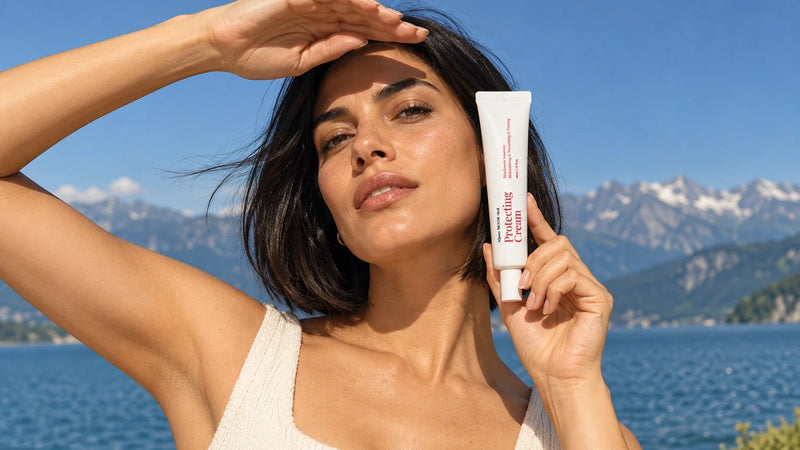
Our Protecting Cream is a protective moisturizer powered by Skin Shield Technology. Its description says it creates a breathable moisture barrier that helps defend skin against external irritants and everyday environmental stressors. It also says peptides and adenosine support smoother, healthier-looking skin. Judge it first as a moisturizer.
What to know first: Protecting Cream contains fragrance, so patch test if your skin is sensitive. It also contains argan, sunflower seed, and macadamia oils, so if you are prone to breakouts, start on a small area. It is a cosmetic, not a medicine. For skin that often feels dehydrated, see our dehydration collection, and speak to a dermatologist if irritation continues.
FAQ
Can peptides replace ceramides in a barrier cream?
No. Ceramides, cholesterol, and fatty acids are lipids that make up the skin's own outer layer, and peptides are a different kind of ingredient. Think of peptides as support alongside moisture and lipids, which is why the base of a cream matters.
Will Protecting Cream feel greasy or heavy?
It is designed to provide nourishing moisture without a greasy or heavy feel. Fast-absorbing seed oils and peptides help nourish the skin, leaving it feeling soft, comfortable, and protected with a non-greasy finish.
When should I use Protecting Cream?
Use it daily in your morning and evening routine. In the morning, apply it before sunscreen to help defend skin against daily environmental stressors. At night, use it as the final moisturizing step to help seal in hydration.
Do I need a peptide cream at all?
Not necessarily. A moisturizer you find comfortable and use regularly matters more than any single ingredient. If your skin stays dry or irritated, a dermatologist can help you decide what to change.