What does “dermatologically tested” mean on a label?
The phrase suggests that a dermatologist was involved in testing a product. It does not say which test was used, how many people took part, whether any had sensitive skin, or what the results were. A label alone cannot answer those questions.
Take the phrase as a prompt to look further, not proof that a product will suit you. Skin reacts to individual ingredients, so a tested product can still bother one person.
Is it the same as hypoallergenic?
No, they are different phrases. The U.S. Food and Drug Administration page, current as of 2022, says there are no federal standards or definitions for the word hypoallergenic, so it means whatever a company wants it to mean. Limits: this is a government web page that covers only that one word. It does not address wording about dermatologist testing or describe how tolerance or patch testing is done.
Here is how the three common phrases compare.
| Phrase | What it suggests | What the label does not tell you | What to check |
|---|---|---|---|
| Dermatologically tested | A dermatologist was involved in testing | Which test, how many people, what the result was | Ask the brand for details |
| Hypoallergenic | Less likely to cause a reaction | Per the FDA page, no federal standard or definition applies | Ingredient list and a patch test |
| Fragrance-free | No fragrance in the formula | Whether other ingredients bother you | Ingredient list |

How are skincare products usually tested on skin?
One method is the repeat insult patch test. A 2014 peer-reviewed article in the Journal of Drugs in Dermatology describes patches applied at one site every 48 to 72 hours, three times a week, for three to four weeks. A product counts as hypoallergenic if no sensitization appears. Limits: it does not show that the test predicts real-world reactions or in-use tolerance, and the data date from 2014.
The article also notes the lack of a federal definition and that products may lack clinical support for the claim. So a claim can rest on a structured test or on very little, and the label does not say which.
What should you check instead of the label claim?
Read the ingredient list. Look for fragrance, and for any ingredient that has bothered your skin before. Then ask the brand which test it ran and on how many people.
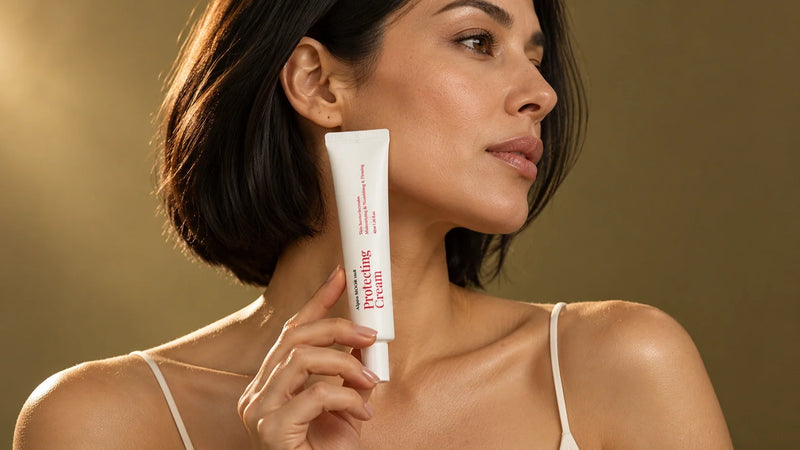
Here is how we apply the same standard to our own cream. Our Protecting Cream contains fragrance, so it is not fragrance-free. It also contains argan, sunflower seed, and macadamia oils, so start on a small area if your skin breaks out easily. It is a cosmetic moisturizer, not a medicine.
It is a protective moisturizer powered by Skin Shield Technology that creates a breathable moisture barrier, helping defend skin against external irritants and everyday environmental stressors, without a heavy or greasy feel. Use it before sunscreen in the morning and as the final moisturizing step at night.

How do you patch test a new moisturizer at home?
Apply a small amount to a small area, such as the inner forearm. Leave it on and watch that spot over the next few days for redness, itching, or stinging. Stop using it if any appear. This is a simple home check, not the clinical test described above, and it does not rule out every reaction.
If you have had strong reactions before, ask a dermatologist before trying a new product. For more on choosing, see our guide to moisturizer for dry, sensitive skin and our redness collection.
FAQ
Is a dermatologically tested moisturizer safe for sensitive skin?
Not necessarily. The phrase does not tell you what was tested or on whom, and skin can react to a single ingredient. A patch test on your own skin is a more direct check than the wording on a jar.
Does fragrance-free mean a moisturizer will not irritate my skin?
No. Fragrance-free only tells you that one ingredient group is absent. Other ingredients can still bother some people, so read the full ingredient list and patch test, even when the label sounds gentle.
What can I ask a brand about its testing?
Ask which test was used, how many people took part, whether the group included people with sensitive skin, and whether you can read the results. Clear answers help you judge a claim.
When should I see a dermatologist about a reaction?
See one if redness, itching, swelling, or a rash lasts after you stop using a product, or if a reaction is strong. A dermatologist can work out the cause, which a label cannot do.